WHY CONTINUOUS LEARNING MATTERS IN 24/7 NETWORK OPERATIONS
A certification does not fix an outage at 3am. A trained engineer does.
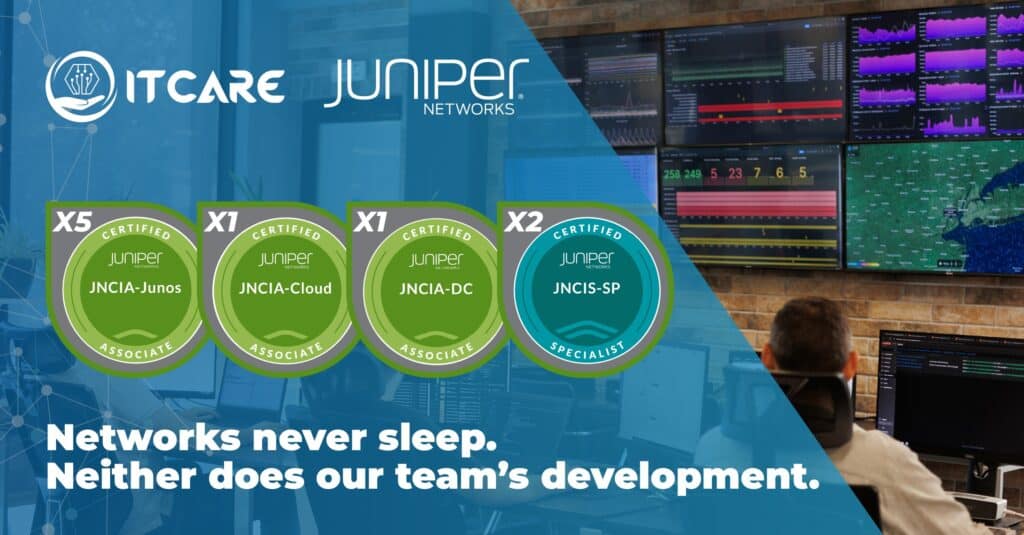
That distinction matters more than most procurement checklists admit. Over the past two months, our NOC team cleared nine Juniper certifications across four tracks. This post is not a trophy cabinet. It is an explanation of why we spend shift hours and study budget on protocol depth, and what each track actually changes about how an incident gets handled.
When an ISP or hosting provider evaluates a 24/7 managed NOC, the questions are usually about coverage, SLAs, and tooling. Fair questions. But the variable that decides whether a 3am incident lasts 12 minutes or 2 hours is the engineer on shift, and specifically whether that engineer understands the protocol or just the dashboard.
What the Team Cleared
Nine certifications in two months, on top of full shift rotations:
- Five JNCIA-Junos
- One JNCIA-Cloud
- One JNCIA-DC
- Two JNCIS-SP
Every exam was passed while carrying a normal on-call load. Nobody was pulled off rotation to study.
What Each Track Changes on Shift
JNCIA-Junos: The Common Language
Junos is the operating system under a large share of the networks we monitor. JNCIA-Junos means every engineer on shift reads configuration the same way, navigates the CLI without hesitation, and understands commit, rollback, and the candidate configuration model. That last part matters at 3am: an engineer who understands rollback semantics captures state and reverts safely. An engineer who does not, improvises.
JNCIA-Cloud: The Overlay Reality
More of our clients run workloads where the network boundary is virtual. JNCIA-Cloud covers virtualization, overlay networking, and the constructs that make a fault in a VXLAN fabric look nothing like a fault on a physical link. When the symptom is in the overlay and the cause is in the underlay, an engineer without that mental model chases ghosts.
JNCIA-DC: The Fabric
Data center operators are a core segment for us, and EVPN-VXLAN fabrics fail differently than classic three-tier designs. JNCIA-DC gives the on-shift engineer the vocabulary and the failure patterns of IP fabrics: route type behavior, multihoming, and where to look when a leaf stops learning MACs.
JNCIS-SP: Where Escalations Get Shorter
The two JNCIS-SP passes are the ones that change our numbers the most. Service provider routing and switching is exactly the layer where a Tier 1 shift either resolves an incident or forwards it. An engineer who understands IS-IS adjacency states, BGP session establishment, and MPLS label operations does not escalate “BGP is down.” They escalate “the session is stuck in Active, TCP 179 is filtered somewhere on the return path, here is the traceroute.” Sometimes they do not escalate at all, because they fixed it.
That is the direct link to our incident escalation process: every fault class the NOC team can resolve at Tier 1 is a fault that never wakes a senior engineer. Certification is not the goal. Shrinking the escalation rate is.
Why We Publish This
Clients rarely ask about training plans, but they feel the result. The difference between a NOC team that knows exactly why a session flapped and one that restarts things until the alarm clears shows up in every resolution time we report. Juniper’s certification tracks are one of the few external, vendor-verified signals of that depth, which is why we treat them as an operating requirement rather than a perk.
Continuous learning is part of the job here. The engineers who cleared JNCIS-SP are already looking at JNCIP-SP, and the next JNCIA-Junos cohort starts this quarter. We hold a JNCIE-SP in-house, and the point of the whole ladder is that the person who answers the first alert thinks like the person who designed the network.
To everyone on the NOC team who put in the hours between shifts, well done. The next track is already open.