Inside the PAXIO Network Redesign: One BGP Design, Zero Outage
Some networks are designed. Others accumulate. PAXIO ran business fiber in the Bay Area, and their network had grown the way a lot of provider networks grow, through acquisitions.
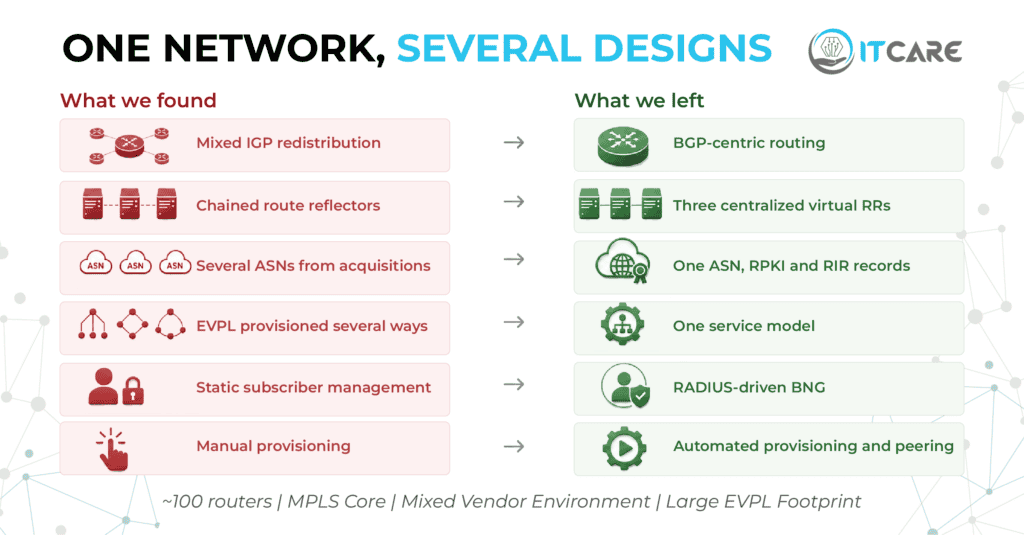
Around 100 routers in the MPLS core, a mixed vendor environment, and a large EVPL footprint that had been provisioned three or four different ways depending on which era of the company built it.
Nothing was broken. That is the part people miss. It all worked. It was held together by knowledge rather than by design, and that ceiling arrives quietly.
We were brought in for engineering, architecture and NOC. The redesign came out of that.
What changed:
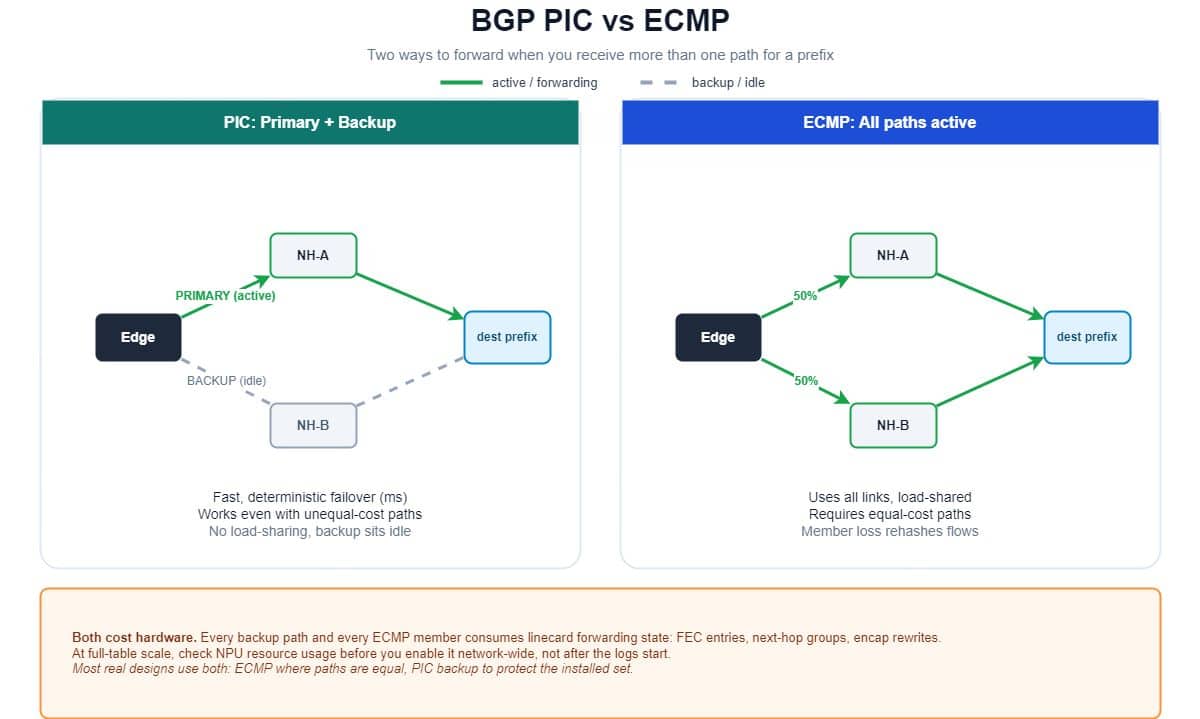
– Routing consolidated from mixed IGP redistribution onto a BGP-centric design, customer prefixes advertised via BGP, traffic tunneled over MPLS.
– Route reflectors rebuilt. A chain of RRs inherited from several networks became three centralized virtual RRs.
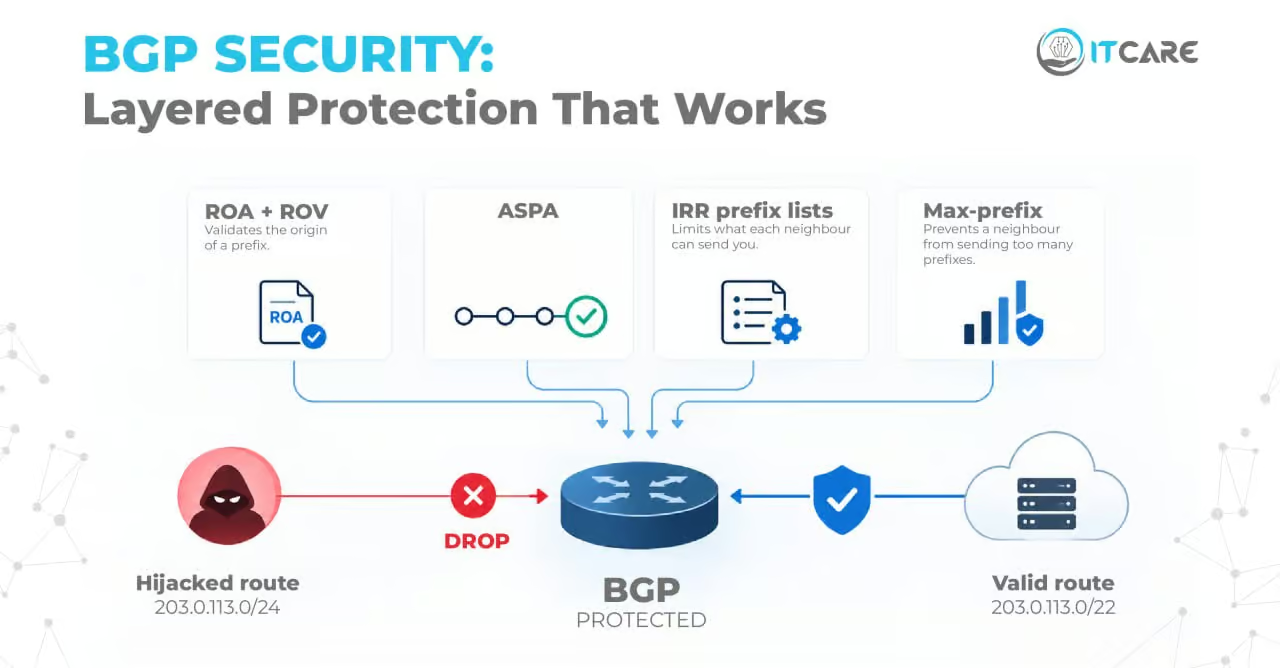
– ASN unified across the backbone. RPKI and RIR records created, all transit and peering moved onto a single ASN, so every upstream finally saw the same prefix set.
– EVPL and L3VPN provisioning standardized onto one service model instead of one per acquisition.
– POPs simplified and redundant hardware decommissioned.
– BNG re-engineered for RADIUS-driven subscriber management.
– Provisioning, peering, monitoring and troubleshooting moved into automation.
Phillip Clark, CEO of PAXIO, on the work at the time:
“Paxio chose ITcare for NOC-as-a-Service and network engineering because we needed a partner that operates with speed, discipline, and accountability. Their 24/7 NOC gives us continuous visibility and fast, structured incident response with clear escalation. Since partnering together, we have seen faster response and more consistent network performance.”
This pattern is not specific to the Bay Area. Any market going through consolidation ends up with networks like this one, several designs coexisting under a single AS number, each of them reasonable at the time it was built. The work is rarely to replace them. It is to pick one design and move everything onto it without an outage.