HORA: The AI Network Operations Platform We Built Inside Our Own NOC
HORA started as an internal tool. Our NOC engineers were tired of opening five systems to answer one question: what actually broke?
The source of truth said one thing. The monitoring stack said another. Topology lived in someone’s head. Flow data sat somewhere else. By the time you had the full picture, the customer had already called.
So we built the thing we wanted. One platform, one pane of glass:
– Inventory, IPAM, circuits, connections
– Metrics and alerting across every vendor
– Logs, all in one place
– Traffic flow analytics, per interface and per circuit
– BGP visibility with BMP
– L1 and L3 topology, discovered automatically
– Config backups
– Configuration Change Management
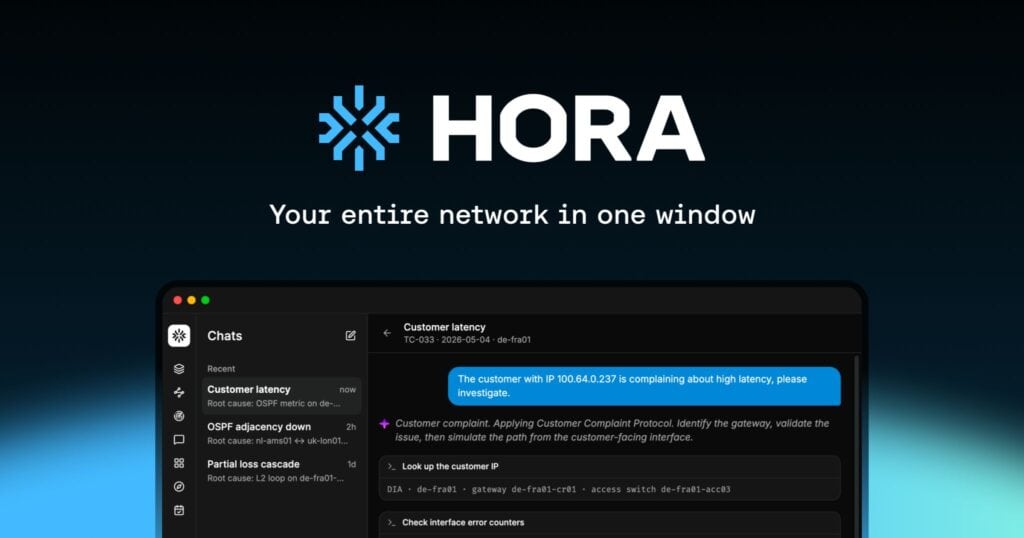
– An AI network engineer that reads all of it and gets to root cause in minutes
It ran inside our own NOC long before we showed it to anyone. That is why it got beaten into shape, and that is why we trust it.
Today it runs in production networks belonging to ISPs, WISPs and Data Center operators. On their hardware, inside their perimeter. HORA is on-prem by design, because people who run networks for a living do not want their topology sitting in a vendor’s datacenter. No SaaS in the path, and nothing reports back to us. You choose where the model runs: your own GPU, or a hosted API with your own key.
Two things fell out of building it this way.
It had to work where engineers actually are. Slack, Teams, Telegram. Asking “is the uplink on acc-sw-04 up?” from a phone at 2am is a real use case, and it needed a real answer grounded in live network state.
It had to be honest about state. Discovery models what is actually deployed, not what someone documented two years ago, and every change is auditable.
We kept HORA quiet while it earned its keep. It has earned it.
Want to see it running against your own network? Comment here, book a demo on the landing page, or email [email protected]