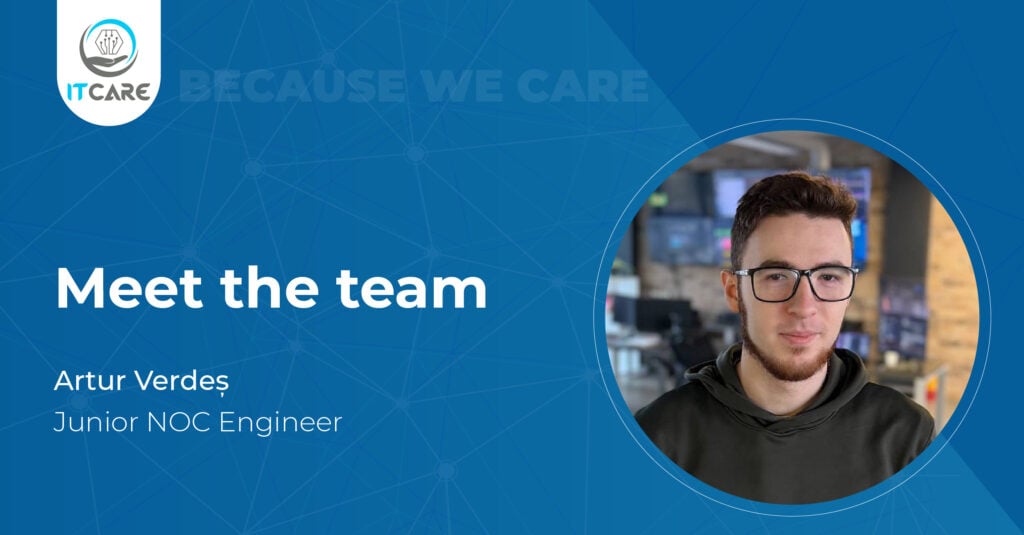
MEET THE TEAM. ARTUR VERDEȘ. JUNIOR NOC ENGINEER
Life in a NOC moves fast. Experience is shaped by real incidents, real networks, and real decisions. Over the past year at ITcare, Artur Verdeș has been navigating exactly this environment.
Before we talk about your role at ITcare, who is Artur Verdeș outside of work, and how would you describe yourself?
Outside of work, I usually play video games, do some coding, and take networking online courses that expand my knowledge and help me in my career. I am constantly developing my skills to handle my workload more effectively.
How did you decide to pursue a career in networking, and what led you to join ITcare?
I learned about networking in college, where I had a great mentor who taught me all the basics. I took several courses, and shortly after that I got my first experience as a system administrator. Over time, I became more experienced. This is when I received a job opportunity to join ITcare as a NOC Engineer. This opportunity helped me expand my experience and develop new skills.
How was your transition from theory or previous roles into a Junior NOC Engineer position, and what surprised you most at the beginning?
The scale of the work and the level of responsibility amazed me. A lot of information was new to me. In my previous roles, everything was much more improvised, and many things were already done for me. I liked that at ITcare I could contribute guides and tools to our knowledge base. I also enjoyed working with field engineers and participating in meetings with other teams to implement technologies into client networks. Here at ITcare, I have gained experience with many different network types, all of which contribute to my development as a NOC engineer.
What have you learned at ITcare that you did not expect when you first started?
At the beginning, I did not expect to configure point to point antennas or fine tune access points. I learned how to work with large scale networks and how to keep an eye on everything so that I can react faster to any network event.
What does a typical shift look like for you, and which part of the job do you enjoy the most?
I arrive at the office, greet everyone, set up my workspace, and connect everything to my notebook. We usually have music playing in the office, which helps create a good work atmosphere. The most enjoyable part of my job is seeing the impact on the network, when issues are fixed, incidents are resolved, and configurations successfully solve client problems.
Is there a technical topic that felt difficult at first but now makes more sense?
The variety of vendors and their devices was confusing at first, although managing them became much easier over time. It is very important to keep learning and practicing in order to achieve good results and to be able to reach the root cause of any problem.
What keeps you motivated to keep learning, even during stressful or repetitive moments?
During repetitive moments, I try to summarize and optimize my actions. In stressful situations, I focus on making them less tedious by building playbooks for different scenarios and writing guides that document resolutions.
How would you describe ITcare’s team culture for someone at the start of their career?
It is a team where everyone does their part. It is never shameful to ask for help. It is better to ask once than to pay for mistakes later.
Looking back at your first day at ITcare, what advice would you give your younger self?
I would tell myself to be more patient. Everything cannot be learned in one day. It takes time and practice.
Experience in network operations is not only about technology. It requires structured thinking, continuous learning, and the ability to remain calm in dynamic environments.