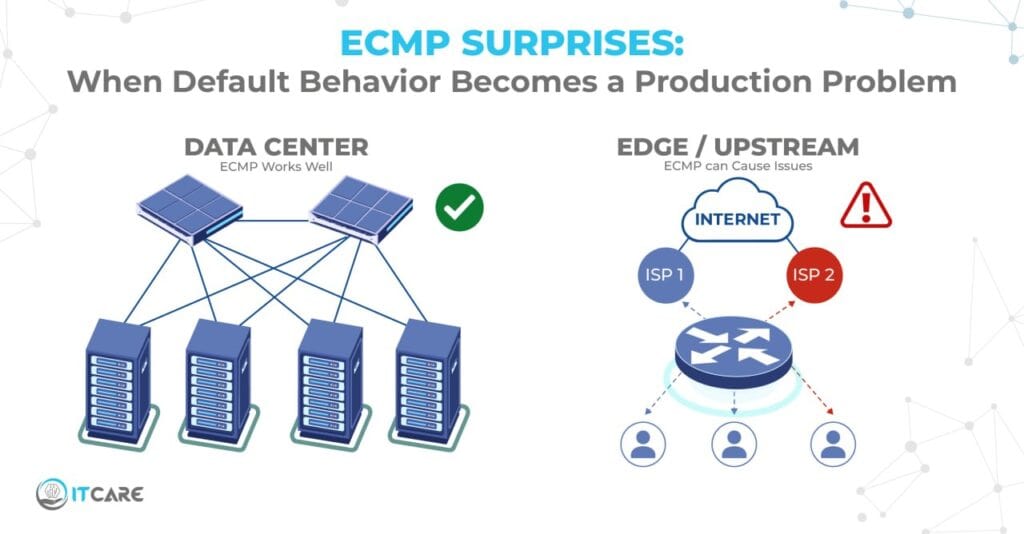
ECMP SURPRISES: WHEN DEFAULT BEHAVIOR BECOMES A PRODUCTION PROBLEM
Equal Cost Multi Path routing is widely used in modern IP fabrics and data center designs, where symmetric paths and predictable traffic patterns are expected. In that context, ECMP is both powerful and appropriate.
However, problems often appear when devices designed primarily for data center roles are repurposed as border or edge routers.
On Arista platforms, one important detail is frequently overlooked. By default, the setting bgp bestpath as path multipath relax is enabled. This instructs the device to treat paths as eligible for multipath even when their AS paths differ, provided the path length is identical.
In data center environments, this behavior is usually harmless. In edge or upstream facing scenarios, it can produce unexpected results.
It is common for the same prefix to be received from multiple upstream providers with identical AS path length but different AS path content. With multipath relax active, the router may install multiple paths and forward traffic using ECMP.
Although forwarding is typically per flow rather than per packet, the operational side effects can be significant. Traffic distribution across different providers introduces variability in latency, jitter, and loss characteristics. From an end user perspective, performance appears inconsistent and difficult to explain.
These situations often lead to confusing troubleshooting cycles. Engineers see stable routing sessions and valid paths, yet application behavior fluctuates depending on which upstream path a flow was hashed onto.
As a practical rule, traffic toward upstream providers is rarely something you want load balanced by default. Edge routing typically demands deterministic and predictable forwarding decisions rather than statistical distribution.
Defaults are not wrong. Misapplied defaults are.
#Networking #BGP #ECMP #Arista #NetworkDesign #Routing #NetOps #ITcare