The era has shifted: UK altnets are now judged on operations, not premises passed
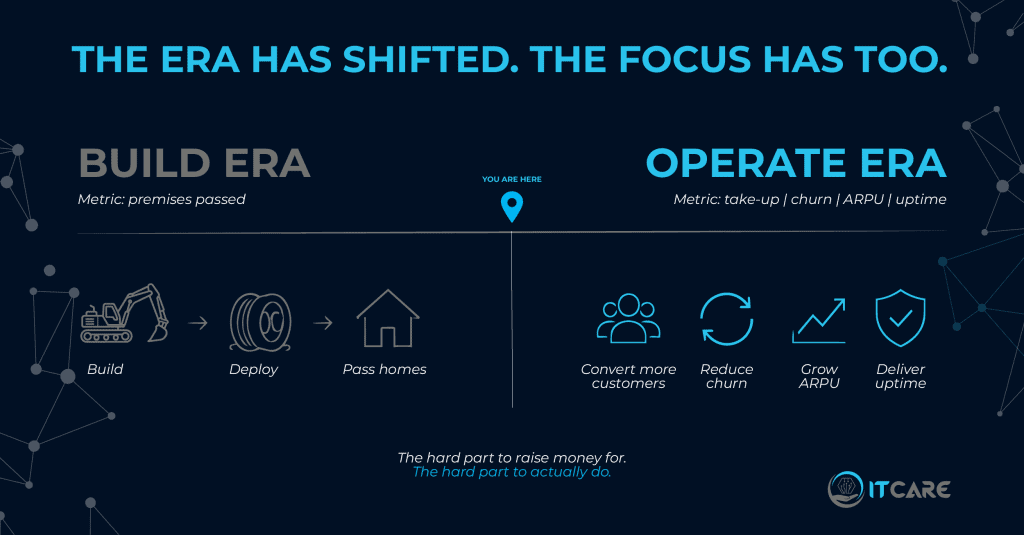
For most of the last decade, a UK altnet was judged on one number: premises passed. Build fast, pass homes, raise the next round on coverage. That era is over.
The proof is the gap between two numbers. By the end of 2025 altnets had passed 19.7 million premises. Average take-up sits around 18 percent. The fibre is in the ground. The customers, mostly, are not on it yet.
Closing that gap is now the whole game, and it is an operating problem, not a building one. AlixPartners put it plainly: operators are no longer judged on network expansion, but on commercialising the infrastructure they already built. The metric has quietly shifted from build speed to take-up, and alongside it churn, ARPU, and the one nobody puts on a slide, uptime.
Here is the uncomfortable part. Operating a network well is a different company than building one, and the difference shows up in the details. A network that passed 400,000 homes but whose live topology exists only in one senior engineer’s head, until the week he is on holiday. Two altnets merge and inherit three monitoring systems, two ticketing tools, and no shared runbook. The overnight incident that waits until morning because the person watching can only escalate, not act. None of this was neglect. During the land grab, operations was not what got rewarded. Now it is the product.
And this is where it reaches the balance sheet. Take-up and churn are downstream of operations. A network that drops customers, or serves them badly at 3am, does not hold the subscribers its business case assumed. With much of the sector facing refinancing soon, that matters more than ever. Diligence no longer stops at coverage maps, it asks how efficiently the network runs. A network that is expensive and fragile to operate is worth less than one that is not, even with identical premises passed.
The build was the hard part to raise money for. Operating it well is the hard part to actually do, and increasingly the one that decides what a network is worth.