ROUTING POLICIES ARE NO LONGER ROUTE MAPS
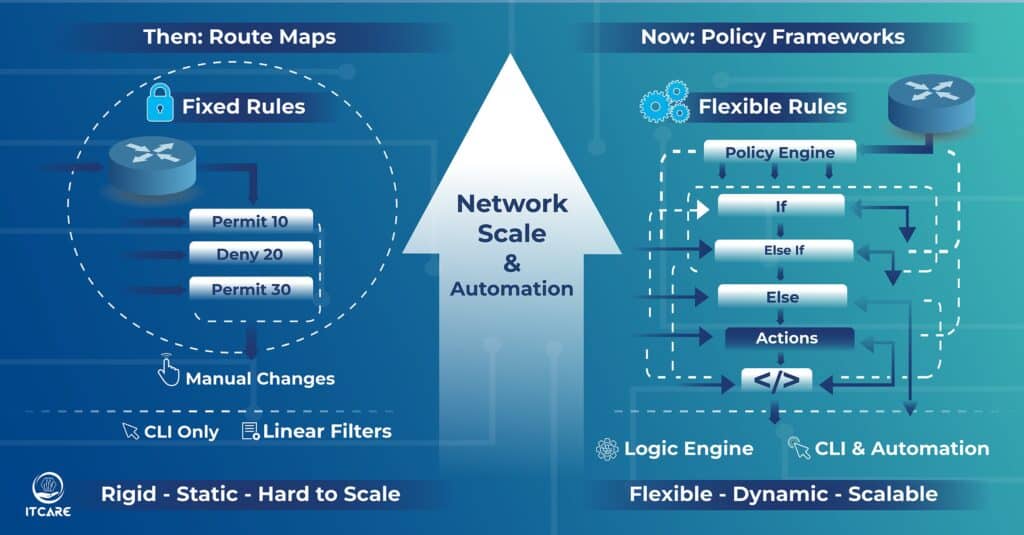
For a long time, routing policy design across many platforms revolved around a single concept. The route map. It worked, but it was rigid, static, and hard to scale. As networks grew and requirements became more complex, this model quickly showed its limits.
Modern service provider and data center networks no longer behave like small static environments. They change often, they are automated, and they must react dynamically to business and traffic requirements. Routing policies had to evolve accordingly.
Today, most major vendors have moved away from classic route maps and introduced policy frameworks that look and behave much closer to code.
Juniper Networks, policy statements have been flexible and hierarchical for a long time. They follow a clear logical structure, allow reuse and conditional evaluation, and can be managed cleanly both via CLI and automation.
Cisco introduced route policy on IOS XR, moving toward a more structured, programmatic approach. These policies allow complex matching and actions, but are less convenient to modify manually because they are typically edited as text files, therefore being more oriented toward automation driven workflows.
Arista Networks introduced Routing Control Functions, which also follow a code like structure. They are powerful and expressive, especially at scale, but require precise syntax knowledge because policies are defined and pushed as text artifacts.
Nokia offers flexible route policies with a strong logical structure that aligns very well with large scale service provider environments. Similar to Juniper, they can be managed efficiently through both CLI and automation.
The real value of these modern policy frameworks becomes clear when automation enters the picture. Structured policies can be generated, validated, and updated programmatically, enabling faster changes, fewer mistakes, and far better consistency.
Routing policies are no longer just filters. They are logic engines that directly influence how traffic flows through modern networks.
Did you already embrace these new ways of defining routing policies, or are you still relying on old fashioned route maps?