The NOC staffing math problem: why one 24/7 seat takes 6 to 7 engineers
Most operators do not have a NOC problem. They have a NOC math problem.
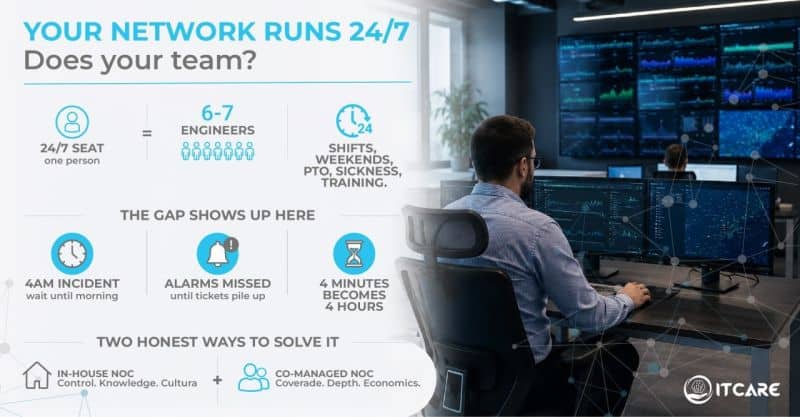
A single 24/7 seat, one person watching your network at every hour of every day, is not one hire. Once you account for shifts, weekends, PTO, sickness and training, covering that seat properly takes 6 to 7 engineers. For many networks that is simply not justifiable, and so overnight coverage quietly falls on whoever picks up the phone.
That gap does not show up on an org chart. It shows up in customer experience. The 4am incident that waits until morning. The alarm nobody senior sees until the tickets pile up. The outage that was 4 minutes of work and became 4 hours because the person watching could not act on it.
There are two honest ways to solve this, and neither is wrong.
In-house wins on control, culture and institutional knowledge. Your team knows your network in a way nobody external ever fully will. If you can afford the headcount, it is a real advantage.
Co-managed wins on coverage, depth and economics. An external NOC works alongside your internal team, taking the overnight and weekend load and bringing engineers who have seen more networks than any single operator ever will. Your team keeps what matters most: architecture, strategy, the direction of the network. The external side extends their reach, it does not take their place.
The point is not that one model beats the other. It is that leaving the gap open is the only genuinely bad option. A network that goes quiet at night is not saving money. It is deferring the cost to the worst possible moment.
If your overnight coverage still depends on one person being awake, it is worth doing the math honestly. That is a conversation we are always happy to have.