

IPoE vs PPPoE on the Same ONT
How two WAN interfaces and one Circuit-ID made RADIUS kick healthy PPPoE sessions
Customer Story
IPoE vs PPPoE is normally a design choice. On this network, some ONTs had made both choices at once.
An ISP running netElastic vBNG with Splynx as its AAA saw about 10 subscribers lose their PPPoE sessions every 90 minutes. There was no physical problem, authentication succeeded, and the vBNG logged the same reason every time, dmcoa kick session. The first read was a session problem on the BNG. The BNG was following orders. Each drop was a RADIUS Disconnect-Request from the AAA, triggered by a second WAN interface on the subscriber’s own ONT.
| Symptom | About 10 subscribers, a PPPoE drop about every 90 minutes, no physical cause |
|---|---|
| Root cause | PPPoE and IPoE WANs on one ONT shared one Circuit-ID, so each new login kicked the session before it |
| Time to root cause | Under 24 hours from ticket to diagnosis |
| Fix | The access provider replaced the ONTs on the affected lines. No change on the BNG or in Splynx |
| Result | The drops stopped after the ONT replacement |
Engineering
Client: Confidential
Industry: Internet Service Provider
Services: Professional Network Services
Technologies: PPPoE, IPoE, RADIUS, Circuit-ID, DHCP Option 82, netElastic vBNG, Splynx
The network
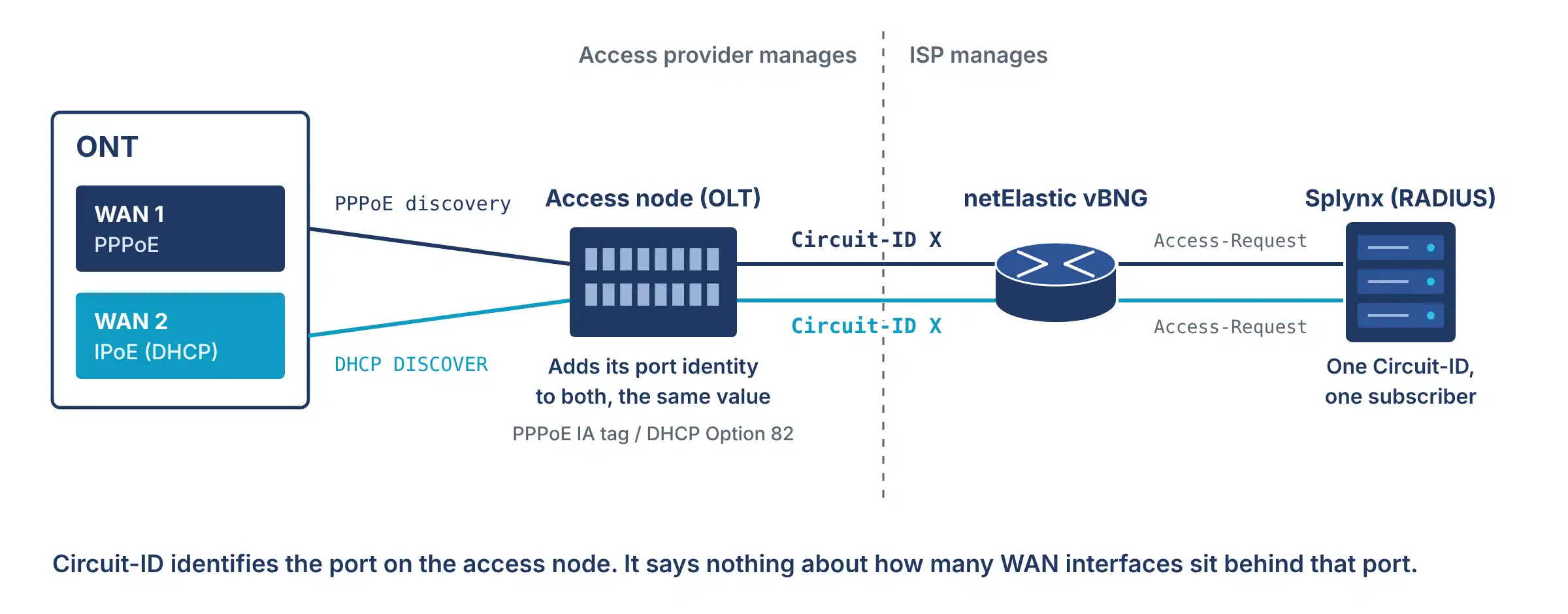
The ISP delivers service over last-mile infrastructure leased from another operator, a common setup in wholesale broadband where one provider serves several ISPs from the same access network. Who owns what matters in this story.
- The access provider runs the access network, the ONTs and the access nodes that tag subscriber traffic with a Circuit-ID.
- The ISP runs subscriber authentication, IP address assignment and Internet connectivity, on netElastic vBNG and Splynx.
Subscribers are identified by the physical circuit, with no passwords on customer equipment. PPPoE uses the Circuit-ID from the PPPoE Intermediate Agent tag, and IPoE uses the same value from DHCP Option 82. It is the model we described in our software BNG case study.
What we saw
About 10 subscribers were affected. Their sessions came up normally, they got an IP address, traffic passed, and then the session was terminated. They could reconnect straight away, and about 90 minutes later it happened again.
Physical faults don’t keep a schedule, so something was firing on a timer. The session history on the vBNG showed three things:
- The disconnect reason was always
dmcoa kick session. ADMIN RESETevents appeared alongside the kicks.- The access interface changed between sessions, which later fit the picture of two WANs taking turns.
Following the disconnect reason
dmcoa kick session points at RADIUS Dynamic Authorization. RFC 5176 lets an AAA server send unsolicited messages to the BNG on UDP port 3799. A CoA-Request changes a live session. A Disconnect-Request ends it, and the BNG answers with a Disconnect-ACK or NAK. The ACK can carry Acct-Terminate-Cause 6, Admin-Reset, so a kick like this can look like an administrator’s action when nobody touched anything.
The Splynx RADIUS logs confirmed it. Splynx was sending Disconnect-Requests for these subscribers, and the vBNG was carrying them out. That moved the question to the AAA. Why was it ending sessions that were working?
Two WAN interfaces behind one Circuit-ID
We lined up the authentication requests against the session history, by timestamp, MAC address and Circuit-ID. Each kick followed a new authentication for the same subscriber. The affected ONTs were bringing up two WAN interfaces, one PPPoE and one IPoE (DHCP).
The ONT never talks to RADIUS. One WAN sends PPPoE discovery, the other sends DHCP, and the access node adds its port identity to both. The vBNG then turns each one into an Access-Request carrying that identity.
RFC 4679 defines the Agent-Circuit-Id as the identifier of the access loop port a subscriber’s requests come from. That is why it works as an identity, and it is also the catch. Two WANs behind one port produce one Circuit-ID, and to the AAA that is one subscriber.
The cause sat in the ONTs themselves, and they weren’t ours to change. The ONTs belong to the access provider.
Why the AAA kicked the session
An AAA has two reasonable answers when an online subscriber authenticates again. It can reject the new login, or it can end the old session and accept the new one. Ending the old one is a sensible default, because a stale session after a power cut would otherwise lock the customer out. Splynx documents both behaviors, Check online for rejecting the new login and Prevent duplicate session for ending the old session. What we saw matches the second.
With one WAN on the port, that logic is fine. With two, it is a loop. The DHCP request kicks the PPPoE session, PPPoE dials again, and that login kicks the IPoE session. It repeated about every 90 minutes. That rhythm fits a retry or lease timer on the ONT, though we did not track down which one.
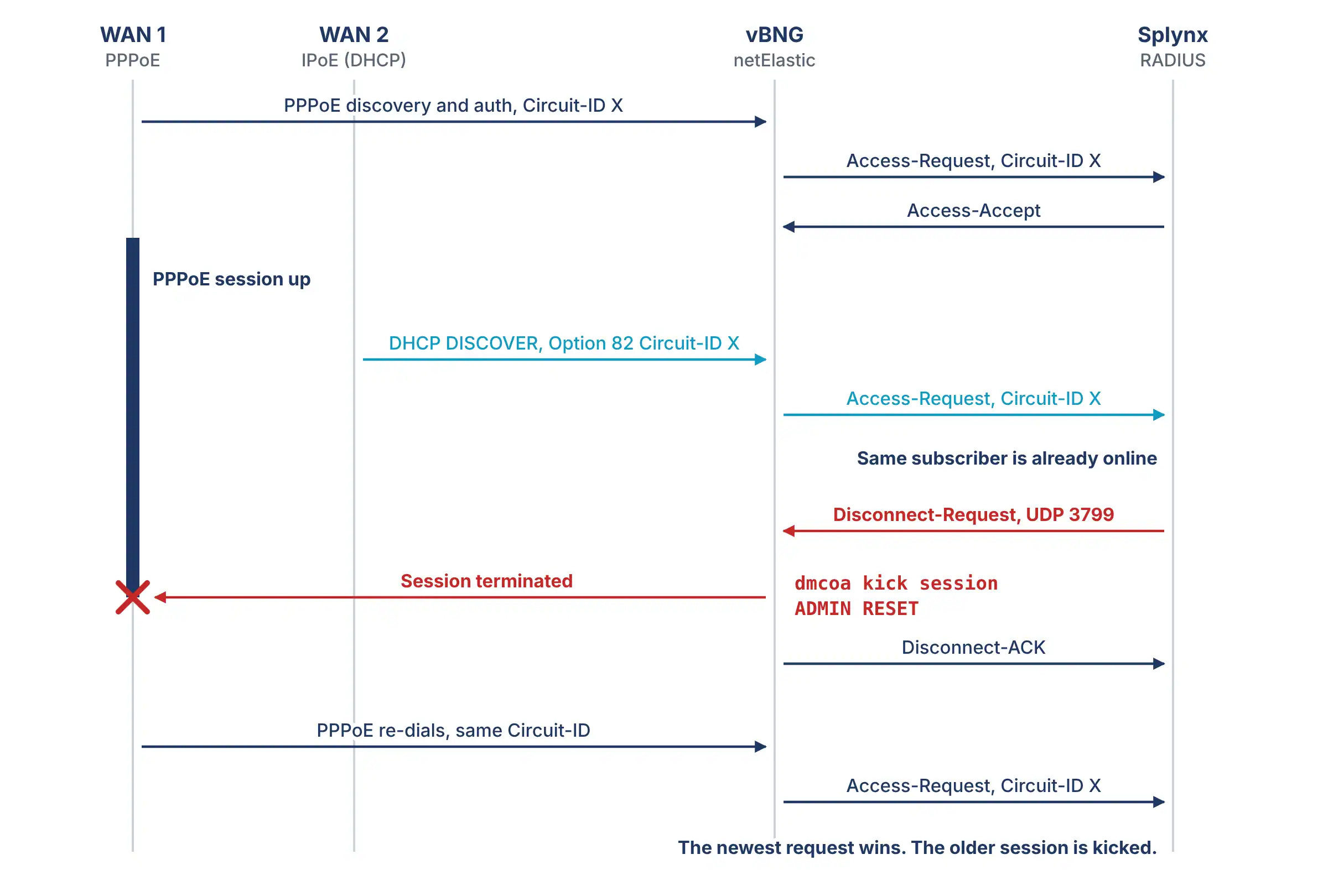
From the vBNG’s side everything was correct. A valid Disconnect-Request arrived and it ended the named session. From the subscriber’s side the Internet kept dropping at random.
IPoE vs PPPoE on one port
Identifying subscribers by circuit is still the model we recommend. It removes credentials from customer equipment and the support tickets that come with them. It does carry one assumption, one port and one access method. When you own the ONTs you can enforce that. On wholesale access, someone else’s ONTs can break it, and nothing in your own config will show it.
| PPPoE | IPoE | |
|---|---|---|
| Session | Explicit session with discovery and LCP | No tunnel, session state follows the DHCP lease |
| Identity on this network | Circuit-ID from the PPPoE Intermediate Agent tag | Circuit-ID from DHCP Option 82 |
| What triggers RADIUS | PPP authentication | DHCP request reaching the BNG |
| Overhead | 8 bytes, 1492 MTU on a 1500 link | None |
The fix
The problem sat in the ONTs. The access provider replaced the ONTs on the affected lines, and the 90-minute drops stopped. We changed nothing on the BNG or in Splynx, because neither was broken.
That also leaves the catch in place. Any ONT that brings up a second WAN behind the same Circuit-ID would start the same loop, and the ISP would not see it in its own config.
Results
- The drops stopped once the affected ONTs were replaced.
- Root cause found in under 24 hours from the ticket.
- No changes needed on the BNG or in the AAA.
Lessons from production
- Read the disconnect reason before you debug the box that logged it. A DM or CoA reason means something outside the BNG asked for the kick.
- Correlate every Disconnect-Request with the authentication right before it. The BNG log tells you where the session ended, and the AAA log tells you why.
- A Circuit-ID identifies a port, and one port can carry more than one client. If PPPoE and IPoE authenticate by the same value, decide what happens when both show up.
- Know what your AAA does with a duplicate login. Kicking the old session and rejecting the new one fail in different ways, so test both with two WANs on one ONT.
- On wholesale access, treat the ONTs as an outside dependency. Know which models and firmware your subscribers sit on, ask to be told when they change, and watch your session data for more than one MAC on a Circuit-ID.
Where this fits
This applies to any ISP that authenticates by Circuit-ID or DHCP Option 82 on access it does not fully control. If your BNG logs kicks you cannot explain, start with the AAA.
If you want a second pair of eyes on your subscriber edge, or you want it designed and operated for you, talk to us.
FAQ
What is the difference between IPoE and PPPoE?
PPPoE builds an explicit session over Ethernet, with discovery, LCP and authentication, and adds 8 bytes of overhead. IPoE sends plain IP over Ethernet and usually gets its address from DHCP, with the subscriber identified by Option 82 or MAC address.
What does dmcoa kick session mean?
In our case on netElastic vBNG, it meant the BNG ended the session because it received a RADIUS Dynamic Authorization request, here a Disconnect-Request from the AAA. The BNG is reporting the action, so check the AAA logs for what triggered it.
What is a RADIUS Disconnect-Request?
A message defined in RFC 5176 that an AAA server sends to a NAS on UDP port 3799 to end a subscriber session. The NAS answers with a Disconnect-ACK or Disconnect-NAK. A CoA-Request changes a live session without ending it.
Can one ONT run PPPoE and IPoE at the same time?
Yes. ONTs commonly support several WAN connections, for example for Internet, voice and management. It becomes a problem when two of them authenticate as the same subscriber, which is what happens when both share one Circuit-ID.
Why would RADIUS disconnect a healthy PPPoE session?
Usually because the AAA ordered it, after a billing or plan change, an administrator’s action or a duplicate-session rule. If a new login for the same subscriber appears just before each kick, look for a second client behind the same port.
be our next success story!
Drop us a line! We care for your Business and are here to answer your questions 24/7