

Building an SDN Router
SDN Router project
Customer Story
A large telecommunications company was facing a major challenge: their existing hardware routers were expensive, inflexible, and difficult to scale. They were also locked into a contract with a single vendor, which limited their options and made it difficult to negotiate better prices.
They wanted an SDN router built on open components: scalable, affordable, easy to manage, and free of vendor lock-in.
Design / Engineering
Published: October 5, 2023
Client: Under NDA
Industry: Enterprise
Solution
A disaggregated software router built on VPP (Vector Packet Processing) and FRR (Free Range Routing), running on Intel DPDK-capable NICs, addresses all three problems at once.
What is VPP?
VPP is an open-source, high-performance software data plane that handles routing and forwarding functions. By harnessing the power of vector processing to process multiple packets simultaneously, it delivers significant performance enhancements.
Evaluating VPP Performance
While the full performance potential of VPP remains untapped, numerous presentations and benchmark tests have demonstrated its huge power:
– Comfortably manage to forward over 100 Gbps at the edge
– FD.io claims VPP can function as a Terabit software router, as asserted in their whitepapers and presentations.
– VPP has demonstrated capabilities of encrypting traffic and forwarding at speeds comparable to hardware routers processing unencrypted traffic.
– It has also shown capacity for loading more than 500,000 routes per second in FIB.
Source:
- VPP Performance benchmarks
- FD.io VPP whitepaper
- FD.io Ice Lake demo results
- Independent VPP performance report
These numbers matter because they close the argument against a software based router. For years the assumption was that real forwarding performance required custom ASICs. On modern CPUs with DPDK, that assumption no longer holds for most edge and aggregation roles.
What is FRR?
Free Range Routing (FRR) is an advanced, open-source routing protocol suite that facilitates dynamic routing on networks. It provides support for both IPv4 and IPv6 protocols, and includes features such as BGP, OSPF, and RIP, among others. FRR’s main advantage is how cleanly it integrates with open networking stacks. It runs in production at scale across the industry: NVIDIA Cumulus, 6WIND, NetDEF, and Orange all build on it.
Why a Disaggregated SDN Router Cuts Cost
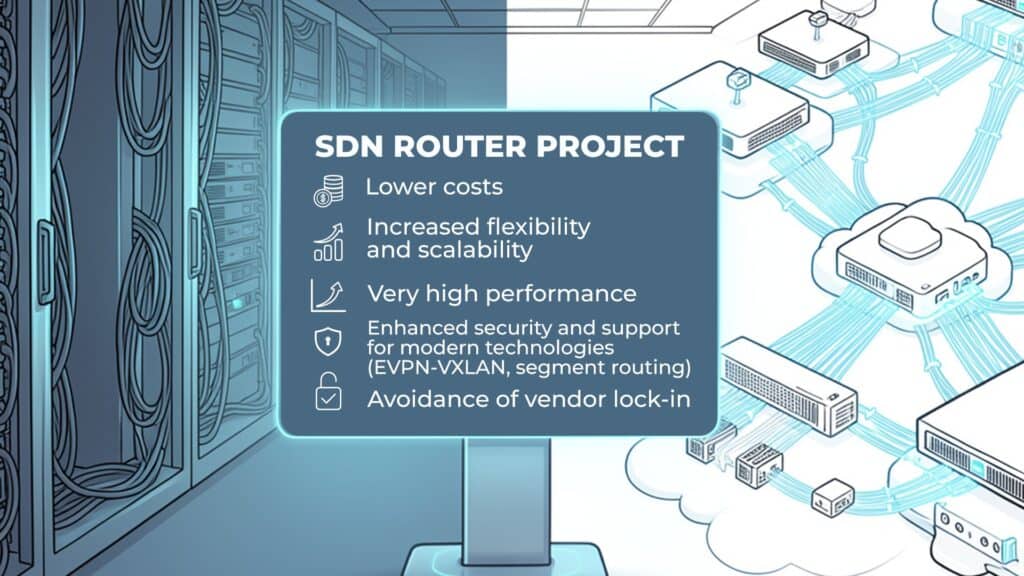
Integrating FRR with VPP, we are developing a highly efficient, contemporary, disaggregated, and scalable software router. Notably, it accommodates cutting-edge technologies such as EVPN-VXLAN and Segment Routing. Furthermore, it provides the option to forward everything in an encrypted format, thereby enhancing the security of your infrastructure.
Deploying software routers on commodity hardware can substantially slash the cost of network infrastructure, providing a cost-effective alternative to expensive hardware routers that also bind organizations to specific vendors. In terms of agility, software routers surpass their hardware counterparts in ease of management and deployment, enabling network operators to promptly introduce new services and adjust to fluctuating customer demand.
This is the same white box router model that hyperscalers have run for years, applied to operator networks: standard x86 hardware, open routing software on top, and the freedom to swap either layer independently.
Our Experience with Software Routers
We have guided numerous clients in implementing software routers based on VPP and FRR using Intel DPDK line cards. Our notable achievements include helping a major telecom operator reach 100 Gbps throughput for each customer and enabling a large enterprise to secure global connectivity.
In each deployment we handled the full cycle: hardware selection, NIC and driver tuning, VPP and FRR integration, and handover to the customer’s operations team with documentation and monitoring in place.
Conclusion
A disaggregated SDN router built on VPP and FRR delivers hardware-class forwarding at commodity-hardware cost: 100 Gbps per edge node in this deployment, with EVPN-VXLAN and segment routing support and no vendor contract dictating the roadmap. We have taken this stack to production for multiple operators, and the pattern repeats: performance goes up, spend and lock-in go down.
be our next success story!
Drop us a line! We care for your Business and are here to answer your questions 24/7