
What Is Network Engineering, and What Does a Network Engineer Do?
Every network that carries real traffic was engineered by someone. Not just wired up, engineered: designed to route correctly, fail predictably, scale without a rebuild, and stay secure while doing it. That work is network engineering, and this is a plain explanation of what it covers and when you need it.
What is network engineering?
Network engineering is the discipline of designing, building, securing, and operating the networks that move data between systems, sites, and users. It spans the physical layer, routers, switches, optics, and cabling, and the logical layer, the routing protocols, addressing, segmentation, and policies that decide how traffic actually flows. On a small network you can improvise. On a network that carries production traffic for an ISP, a data center, or a hosting platform, improvisation is what causes outages.
A useful way to see it: a network administrator keeps an existing network running day to day. A network engineer decides how that network should be built in the first place, and rebuilds it when it stops scaling. The two overlap, but the engineering side is where the architecture decisions live.
What a network engineer actually does
The work is more proactive than reactive. A good engineer spends more time preventing failures than fixing them. Day to day that means:
- Designing the topology: spine-leaf fabrics, aggregation and edge layers, redundancy, and failure domains that contain a fault instead of spreading it.
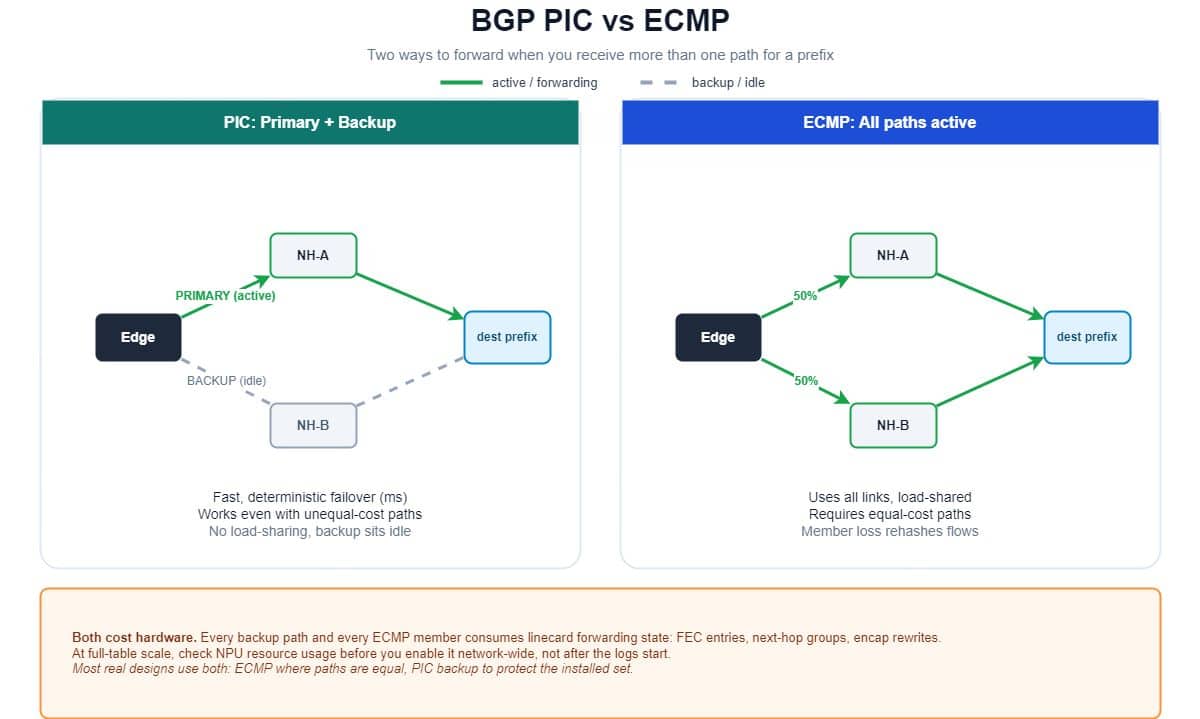
- Configuring routing: BGP for external and internal reachability, OSPF or IS-IS inside the network, and the policies that control which routes are accepted, preferred, and advertised.
- Building for scale: EVPN-VXLAN fabrics, MPLS, peering, and IP transit designed to grow by adding capacity, not by forklifting the whole thing.
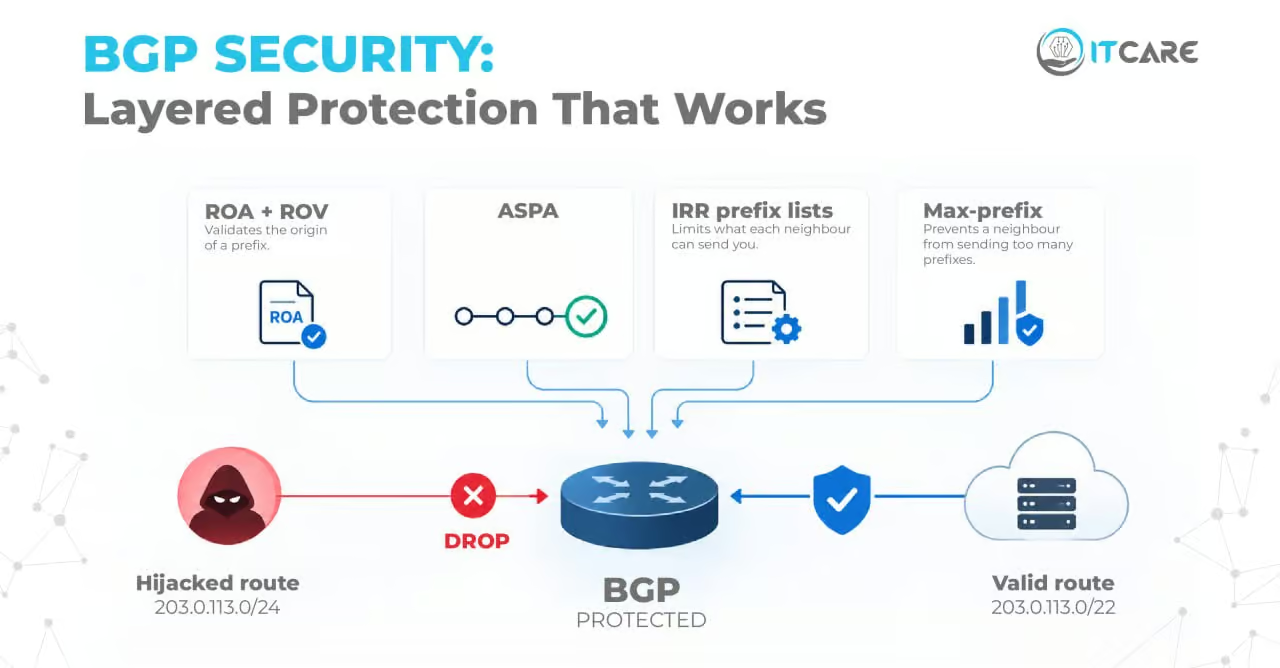
- Securing the path: RPKI for route origin validation, segmentation, access control, and control-plane protection.
- Making it observable: monitoring, telemetry, and a single source of truth so the state of the network is known rather than assumed.
Most of this happens across more than one vendor. Real networks run a mix of Arista, Juniper, Nokia, Cisco, and whitebox, so the engineering has to work across all of them rather than depend on one.
The tools and protocols network engineers work with
You do not need to memorize the toolkit, but it helps to recognize it. Routing lives in BGP, OSPF, and IS-IS. Data center fabrics run EVPN-VXLAN. Service provider cores run MPLS. Automation and source of truth come from tools like Ansible, Terraform, and NetBox. Monitoring and telemetry come from stacks like Zabbix, Prometheus, and Grafana. The point of the toolkit is consistency: changes that are fast, repeatable, and auditable instead of hand-typed one box at a time.

When you need network engineering expertise
You need it earlier than most teams think, which is before something breaks rather than after. The clear signals are a network that works today but is starting to strain as you add customers or sites, a migration or data center build on the horizon, incidents that need L3 routing knowledge your team does not have in house, or documentation that no longer matches reality. Networks that run fine at one hundred customers routinely fall over at seven hundred and fifty, and the difference is almost always design.
This is the core of what we do at ITcare. We handle network architecture and engineering for ISPs, data center operators, and cloud and hosting providers, the same engineers designing the fabric and, through our 24/7 NOC, keeping it running. Increasingly that work is backed by HORA, our AI NetOps platform, which shortens root cause analysis on live networks. If you are designing something that has to carry real traffic, that is the point to bring an engineer in.
Certifications that matter in network engineering
You want engineers who don’t just claim expertise, but they prove it. Certifications show that they’ve met vendor or industry standards for specific skills.
Key certifications to look for:
Cisco CCNA, CCNP, or CCIE;
Juniper JNCIA, JNCIS, JNCIP;
AWS Solutions Architect – Associate;
Certified Kubernetes Administrator (CKA);
Linux Professional Institute Certifications (LPI);
ISO 27001 knowledge for security alignment.
At ITcare, our engineers hold all of the above, giving you full confidence that the people behind your infrastructure meet global standards.
If you want predictable performance, secure access, and the freedom to grow your business without worrying about the backend, you need a network that’s built with care, foresight, and technical precision.