NOC vs Service Desk: Why the Handover Is the Most Expensive Part of an Outage
The most expensive part of an outage is rarely the failure. It is the time between detection and the first person who can actually fix it.
Redundancy does not save you from everything. Some failures never trigger the fallback: a path that degrades without going down, a node that misbehaves without failing, an upstream transit problem that is invisible to your own monitoring. The network is designed correctly, and customers are suffering anyway.
The question is not whether the network was designed well. It is who is watching the moment it degrades anyway.
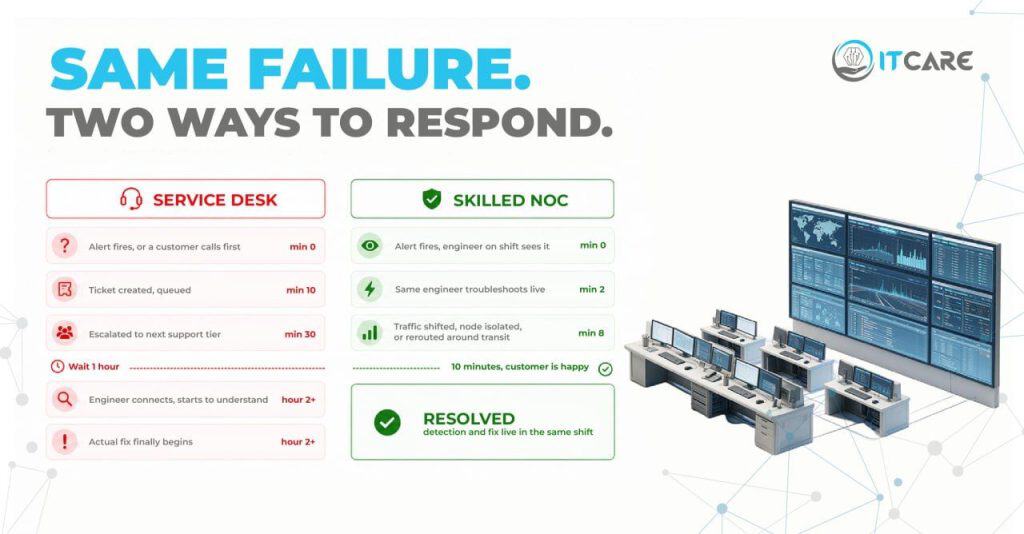
With a service desk, the sequence is familiar. An alert fires or a customer calls. A ticket is created. It is escalated. Somewhere, hours later, an engineer opens a laptop, connects, and starts to understand the problem. Only then does the actual fix begin.
With a skilled NOC, the person who detects the problem is the person who can resolve it. Shift traffic to the backup path. Isolate the misbehaving node. Reroute around the transit provider having a bad day. Minutes, because there is no handover between seeing and fixing.
The gap between those two sequences is measured in revenue. In ITIC’s latest survey, 91% of mid-size and large enterprises put the cost of 1 hour of downtime above 300,000 USD. Uptime Institute’s 2026 outage analysis found 1 in 5 impactful outages now cost more than 1 million USD. Those numbers are decided in the handover. The minutes that matter are the ones before someone with enable access and a working picture of the network is actually looking at it.
A Service Desk ticket queue records the outage. A NOC shortens it.
We run the second kind. Detection, troubleshooting, and resolution in the same shift, by the same engineers, around the clock.