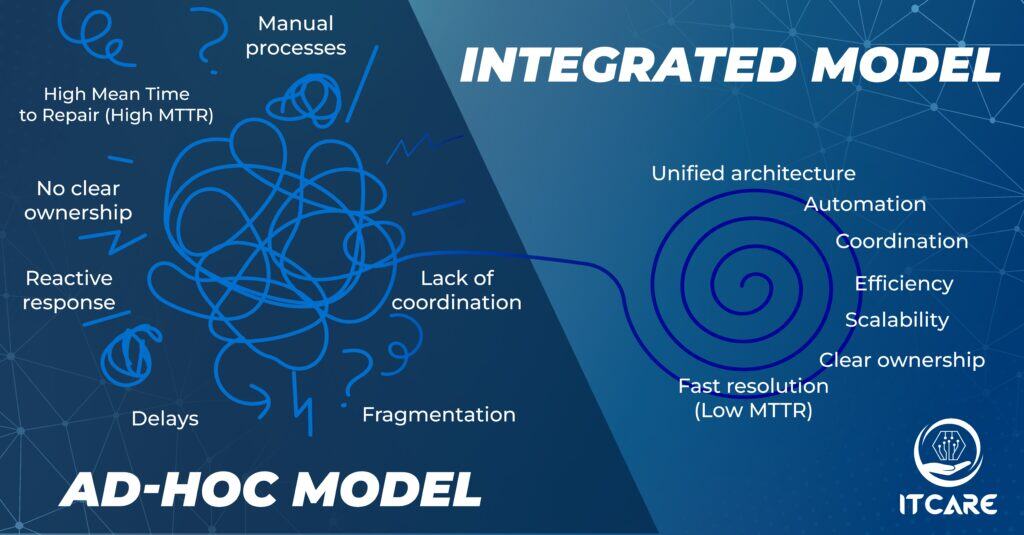
AD-HOC MODEL vs INTEGRATED MODEL
Many fiber ISPs still treat managed network support as a safety net, something you call when after-hours alarms start ringing.
But today’s networks are far more complex than the ticket triage model was ever designed to handle.
Why ad-hoc support leaves blind spots
When traffic patterns shift, service portfolios diversify, and capacity needs scale overnight, a piecemeal “call-handling” approach leaves dangerous blind spots:
- No cohesive architecture alignment with long-term growth plans
- Provisioning delays caused by manual, inconsistent workflows
- Fragmented troubleshooting across multiple vendors with no ownership of root cause
The integrated managed network support model
A more sustainable model we are seeing gain traction combines three capabilities under one operational umbrella:
- Architectural Planning. Rigorous design reviews that tie fiber backbones, peering, and edge aggregation to realistic traffic forecasts and redundancy goals.
- Provisioning Workflows. Automated turn-ups, golden configuration templates, and change management practices that minimize drift and speed up new-service activation.
- Tiered Expertise on Demand. Seamless escalation from routine troubleshooting to deep BGP, MPLS, or data-center routing analysis without having to juggle multiple external contracts.
The impact
- Mean Time to Repair (MTTR) drops as issues are resolved at the right tier the first time.
- Rollout timelines shrink thanks to consistent provisioning pipelines.
- Engineering teams free up bandwidth to innovate instead of firefighting.
For ISPs whose operational challenges go deeper than clearing overnight alarms, moving from ad-hoc support to an integrated, end-to-end model is no longer a “nice to have,” it is a competitive necessity.